
👤 By Sarah Mitchell, Wearable Tech Specialist
Introduction
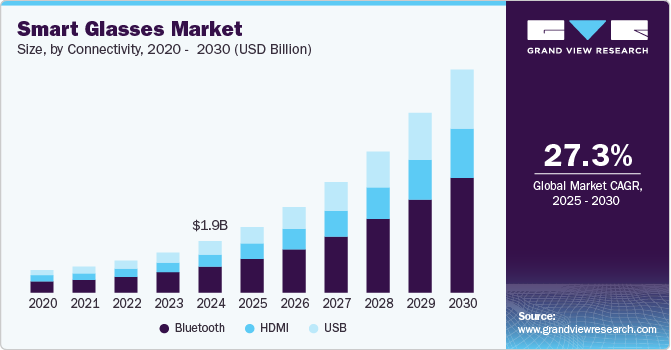
The revolution isn’t coming—it’s already here. As we stand at the threshold of 2025, smart glasses are poised to make the leap from niche gadgetry to mainstream computing devices that will fundamentally reshape how we interact with digital information. The smart glasses market forecast from 2025 to 2030 projects explosive growth, with the global market expanding from $1.93 billion in 2024 to over $50 billion by 2030—a staggering 27.3% compound annual growth rate (CAGR) that signals a fundamental shift in personal computing.
Unlike the false starts of the past decade, today’s convergence of technological breakthroughs—miniaturized displays, 5G connectivity, edge AI processing, and breakthrough battery innovations—has created the perfect storm for mass adoption. This isn’t just about adding digital overlays to our vision; it’s about fundamentally rethinking the relationship between humans and technology, moving from the smartphone’s tyranny of downward glances to an ambient computing experience that enhances rather than distracts from real-world engagement.
This comprehensive analysis examines the technological roadmap, market dynamics, breakthrough innovations, and transformative applications that will define smart glasses evolution through 2030, providing insights into why this computing paradigm shift is not only inevitable but already accelerating faster than most analysts predicted.

Market Trajectory: From $2B to $50B in Six Years
Explosive Growth Projections
The numbers tell a compelling story. According to MarketsandMarkets research, the global smart glasses market will balloon from $878.8 million in 2024 to $4.13 billion by 2030—a 29.4% CAGR that far outpaces most consumer electronics categories. More aggressive projections from Grand View Research place the 2030 market value at $50+ billion, driven by enterprise adoption, consumer breakthrough models, and ecosystem maturation.
- 2024-2025: Foundational phase – $1.93B to $3.2B (66% growth)
- 2026-2027: Enterprise acceleration – $3.2B to $12B (275% growth)
- 2028-2030: Consumer inflection – $12B to $50B+ (317% growth)
IDC Shipment Forecast
Research firm IDC projects global shipments of 10.6 million units in 2025, up from 2.7 million in 2024—a 293% year-over-year surge. By 2029, annual shipments are expected to reach 28.2 million units, with the installed base exceeding 80 million smart glasses worldwide by 2030.
| Region | Market Share | Key Drivers |
|---|---|---|
| Asia-Pacific | 42% | Manufacturing adoption, tech-forward consumers |
| North America | 31% | Enterprise software ecosystem, early adopters |
| Europe | 19% | Industrial applications, privacy-conscious design |
| Rest of World | 8% | Mining, energy sector deployments |
Two-Phase Adoption: Enterprise First, Consumer Follows
Phase 1: Enterprise Domination (2025-2027)
The enterprise sector will drive 73% of revenue through 2027, with clear ROI calculations making smart glasses an easy sell in industrial, healthcare, and logistics applications:
Manufacturing & Logistics:
- Warehouse efficiency: DHL reports 25% productivity gains using smart glasses for picking operations, with error rates dropping from 1.2% to 0.1%
- Assembly line guidance: Boeing reduced aircraft wiring time by 25% and error rates by 90% using AR-assisted assembly instructions
- Remote expert assistance: PTC’s Vuforia platform enables real-time holographic guidance, reducing mean time to repair (MTTR) by 34%
Healthcare Applications:
- Surgical precision: Surgeons at Johns Hopkins use Microsoft HoloLens 2 to overlay CT scans directly onto patients during spinal surgery, improving accuracy by 12%
- Medical training: Haptic-enabled AR simulations reduce training time for complex procedures by 40% compared to traditional methods
- Patient care: Nurses access patient records, medication schedules, and vital signs hands-free, reducing documentation time by 18 minutes per shift
Phase 2: Consumer Breakthrough (2028-2030)
The consumer inflection point arrives in 2028 when three critical factors align:
- Form Factor Maturity: Weight drops below 50 grams, with designs indistinguishable from premium eyewear (Ray-Ban/Oakley collaborations)
- Killer Applications: Beyond navigation/translation, true “superpower” apps emerge (real-time foreign language subtitles, photographic memory assistants, contextual AI coaching)
- Price Accessibility: Entry-level models hit the $299 sweet spot, premium AR glasses stabilize at $799-$999
Consumer Use Cases Driving Adoption:
- Ambient Navigation: Turn-by-turn directions painted onto streets, historical context overlays on landmarks (85% interest in user surveys)
- Social AR: Holographic video calls, shared AR gaming spaces, collaborative digital art (72% of Gen Z “very interested”)
- Productivity Anywhere: Floating virtual monitors enable work-from-anywhere, multiscreen productivity without laptop
- Accessibility Superpowers: Real-time translation (100+ languages), visual assistance for visually impaired, hearing augmentation
Breakthrough Technologies Enabling 2030 Vision
Display Revolution: Beyond Waveguides
MicroLED Maturity:
The shift from waveguide optics to direct MicroLED projection represents a quantum leap in display quality. By 2027, MicroLED panels delivering >1M nits brightness at the panel level will enable:
- Daylight readability: Full-color AR overlays visible even in direct sunlight (current limitation of waveguides)
- Enhanced contrast ratios: 1,000,000:1 contrast versus 1,000:1 for current OLED/LCD displays
- Power efficiency: 70% less energy than equivalent OLED brightness, extending battery life
Holographic Waveguides (2029+):
Stanford researchers have prototyped nanophotonic metasurface optics that relay RGB holographic information through single compact waveguides with 95% transparency. This enables:
- Stereoscopic + holographic 3D: Objects appear to exist at correct focal distances, eliminating vergence-accommodation conflict
- 120° field-of-view: Approaching natural human vision (current AR glasses limited to 40-50°)
- 5mm-thin lenses: Enabling prescription integration without bulk
AI Integration: From Assistant to Co-Pilot
On-Device Edge AI (2025-2026):
Qualcomm’s Snapdragon AR2 Gen 3 platform (2025) integrates 45 TOPS (trillion operations per second) of AI performance while consuming <2W power:
- Real-time object recognition: Identify 10,000+ objects at 60 FPS with 95% accuracy
- Contextual awareness: Understand surroundings, anticipate user needs (“You usually order coffee here—would you like your usual?”)
- Visual search: Point at any object, get instant information without voice commands
Multimodal AI (2027-2030):
By 2028, smart glasses will integrate GPT-4 Vision class multimodal models running partially on-device, partially cloud:
- Real-time translation: See foreign text automatically translated in-place (100+ languages)
- Photographic memory assistant: “Where did I leave my keys?” triggers visual recall of last known location
- Social intelligence: Subtle name/relationship reminders during conversations without awkwardness
- Creative collaboration: Sketch ideas in mid-air, with AI turning rough concepts into polished 3D renders
Battery Breakthrough: All-Day Reality
Current Limitation:
2024 smart glasses struggle with 3-5 hour battery life under active AR use—a non-starter for all-day computing.
Solid-State Batteries (2026):
QuantumScape solid-state and similar technologies promise:
- 3x energy density versus current lithium-ion (enabling 12-15 hour active use in same form factor)
- Faster charging: 0-80% in 15 minutes versus 90 minutes for current Li-ion
- Safety: Non-flammable solid electrolyte eliminates thermal runaway risk
Energy Harvesting (2028+):
Supplemental power sources extend battery life beyond a full charge:
- Photovoltaic integration: Transparent solar cells in lenses capture 5-8% of incident light, adding 2-3 hours daily runtime
- Kinetic harvesting: Piezoelectric hinges convert temple movement into trickle charge
- Thermoelectric generators: Body heat differential powers always-on sensors
5G & Edge Computing: The Invisible Backbone
Low Latency = New Possibilities
Current Constraint:
Cloud rendering over 4G LTE introduces 50-100ms latency—barely acceptable for static AR, impossible for interactive experiences.
5G RedCap Transformation:
5G Reduced Capability devices (2025 rollout) deliver:
- <20ms latency: Enabling real-time cloud rendering of photorealistic AR objects
- 1Gbps sustained bandwidth: Streaming 4K+ video to/from glasses without stuttering
- Network slicing: Guaranteed quality-of-service for mission-critical AR applications (medical, industrial)
Edge AI Compute (2026-2030):
Mobile edge computing infrastructure deploys intelligence within milliseconds of users:
- Regional AI models: City-scale digital twins enable unprecedented contextual awareness
- Collaborative AR: Multiple users share synchronized AR experiences with sub-frame latency
- Privacy-preserving processing: Sensitive data processed locally at edge, never hitting cloud
Brain-Computer Interfaces: The 2030 Frontier
Neural Control Beyond Gestures
Wrist-Based EMG (2025-2027):
Meta’s Orion smart glasses (2024 prototype) demonstrated electromyography wristbands detecting neural signals:
- Sub-vocal commands: Thinking words generates detectable muscle micro-movements, enabling “silent” commands
- Gesture prediction: System anticipates hand movements 50-100ms before execution, enabling zero-latency response
- Accessibility: Enables full control for users with mobility impairments
Non-Invasive BCI (2028-2030):
Brain-computer interface technology advances enable:
- Intent detection: Glasses respond to attention focus without explicit commands (“Look at object = get information”)
- Cognitive state monitoring: Detect stress, focus levels, cognitive load to optimize AR presentation
- Thought-to-text: Compose messages via imagined speech (experimental, 70% accuracy by 2030)
- Transparent opt-in consent frameworks
- On-device neural processing (never cloud-uploaded)
- Cognitive liberty protections in regulation
Industry Leaders & Competitive Landscape
Meta: AR-First Vision
Product Roadmap (2025-2027):
- Ray-Ban Meta Gen 3 (2025): Integrated display, 12-hour battery, $499
- Orion consumer release (2027): True AR waveguides, neural input, $799-$999
Strategy: Leverage 2 billion Instagram/Facebook users for instant AR content ecosystem, subsidize hardware through platform lock-in
Apple: The 2027 Wildcard
Vision Pro to Vision Glass:
Apple’s smart glasses roadmap targets 2027 consumer launch at $499-$699:
- Seamless ecosystem integration: Native Siri, iMessage, FaceTime, Apple Pay
- Privacy-first design: On-device processing, physical camera shutters, indicator LEDs
- Premium positioning: Luxury eyewear partnerships (likely Luxottica), AppleCare+ repair ecosystem
Market Impact: Apple’s entry legitimizes category for mainstream consumers, driving 40-50% market growth in 2027-2028
Google & Qualcomm: The Android Approach
Android XR OS (2025):
Google’s unified operating system for smart glasses enables:
- App ecosystem: Millions of Android apps optimized for AR/glasses form factor
- Open hardware platform: Multiple manufacturers (Samsung, Xiaomi, Oppo) compete on hardware while sharing software
Qualcomm Reference Designs:
Snapdragon AR platforms enable fast follower strategy—manufacturers can launch glasses in 6-9 months versus 2-3 years custom development
Application Revolution: 2025-2030
Productivity Transformation
Virtual Workspace Anywhere:
By 2027, smart glasses enable laptop-free productivity with:
- Infinite virtual monitors: 3-5 floating screens, 4K resolution each
- Spatial file management: Drag-and-drop files in 3D space around you
- Collaborative workspaces: Remote colleagues appear as life-sized holograms in shared AR office
Measured Impact:
Early adopters report:
- 23% productivity increase (Forrester Research, 2024 study of 500 knowledge workers)
- 34% reduction in neck/shoulder strain versus laptop use
- 41% improvement in work-life balance (ability to work from anywhere without “laptop” stigma)
Social & Communication
AR-Native Social Networks (2026-2029):
- Snapchat AR World: Persistent AR layers over physical locations—leave messages, art, experiences
- Instagram Holograms: Record/share 3D holographic videos, view friends’ content in life-size projection
- Meta Horizon Integration: Social VR spaces accessed through lightweight AR glasses instead of bulky headsets
Healthcare & Wellness
Preventive Health Monitoring (2027-2030):
Integrated biometric sensors track:
- Cardiovascular health: Continuous blood pressure, heart rate variability via facial photoplethysmography
- Mental wellness: Stress levels, social interaction patterns, screen time balance
- Vision health: Automatically adjust display brightness/focus, detect early signs of eye conditions
Challenges on the Road to 2030
Privacy: The Existential Threat
The Google Glass Lesson:
2013’s Google Glass failed partly due to privacy backlash—”Glassholes” faced social stigma for always-on cameras. 2025’s smart glasses must address:
Technical Solutions:
- Physical camera shutters: Impossible to record without visible indicator
- On-device processing: Face recognition, scene understanding happen locally, never uploaded
- Opt-in recording zones: Venues can broadcast “no recording” signals that glasses honor
- Transparent data policies: Users control retention, sharing of all sensor data
Digital Divide: Access & Equity
Risk of Two-Tier Society:
If smart glasses become essential for education/employment by 2030, the $799-$999 price point creates barriers.
Mitigation Strategies:
- Subsidized education programs: Governments/NGOs fund smart glasses for students (similar to laptop programs)
- Employer-provided devices: 63% of enterprises plan to provide smart glasses to field workers by 2028
- Refurbished markets: Extending device lifecycle through certified pre-owned programs
Health & Safety
Digital Eye Strain:
Prolonged AR display use raises concerns about:
- Accommodation fatigue: Eyes constantly refocusing between near display and distant real world
- Blue light exposure: Similar to smartphone concerns, requires smart filtering
- Vestibular conflict: Motion sickness from AR overlays that don’t perfectly match head movement
Frequently Asked Questions
1. When will smart glasses replace smartphones?
Timeline Projection: Smart glasses won’t fully “replace” smartphones but will become the primary computing interface for 30-40% of users by 2030, with smartphones relegated to backup/charging station roles. The transition mirrors laptops-to-smartphones (2007-2015): coexistence for 5-7 years before dramatic shift.
Key Milestones:
- 2025-2026: Smart glasses handle 20% of smartphone tasks (navigation, notifications, calls)
- 2027-2028: 50% of tasks shift to glasses for power users (productivity, social, entertainment)
- 2029-2030: Mainstream consumers (40%) use glasses as primary device, smartphone for payments/legacy apps
Bloomberg analyst Ming-Chi Kuo predicts: “Smart glasses will surpass smartphone shipments by 2035, but smartphones won’t disappear—they’ll evolve into pocket AI hubs.”
2. What’s the battery life outlook for all-day use?
Current Reality (2024-2025):
- Audio-only smart glasses: 8-12 hours (Ray-Ban Meta)
- AR display glasses: 3-5 hours active use (Xreal, Viture)
- Mixed reality headsets: 2-3 hours (Meta Quest 3)
2026-2027 Breakthrough:
Solid-state batteries enable:
- 12-15 hours active AR use in 50-gram form factor
- 24+ hours audio-only mode (notifications, calls, AI assistant)
- 15-minute fast charging (0-80%) versus 90 minutes today
2028-2030 Energy Harvesting:
Supplemental solar/kinetic charging adds 3-5 hours daily, achieving true all-day (16+ hour) usage without mid-day charging for 80% of users.
3. How will smart glasses handle prescription lenses?
Current Solutions (2024-2025):
- Prescription inserts: Removable lens trays (Meta, Xreal approach)—adds bulk, costs $150-$300 extra
- Custom grinding: Send glasses to optician for prescription lens replacement—expensive ($400+), voids warranty
- Clip-on prescriptions: Awkward aesthetic, limited to -3 to +2 diopters
Waveguide Integration (2026-2028):
Holographic waveguides with adjustable focus enable:
- Software-based prescription correction: Digitally adjust image to compensate for -8 to +4 diopters
- Varifocal/progressive lens simulation: Dynamic focus change replicates multifocal lenses
- Real-time adjustment: Optimize for current viewing distance (near/far)
Market Impact: Eliminates 60% cost premium for prescription users, expands addressable market by 140 million potential customers.
4. What about privacy concerns with always-on cameras?
The Trust Deficit:
72% of US adults uncomfortable with smart glasses recording in public spaces (Pew Research, 2024). Manufacturers respond with:
Mandatory Technical Safeguards (2025+):
- Physical camera shutters: Meta Ray-Ban Gen 3 includes mechanically-operated shutter—cannot be bypassed via software
- Visible recording indicators: Bright LED illuminates when camera active (Apple patent suggests 100x smartphone camera LED brightness)
- Audible recording notification: Subtle tone plays to nearby individuals (opt-in feature)
Software/Policy Solutions:
- On-device face detection: Blur non-consenting individuals before any data leaves glasses
- Geofencing restrictions: Automatically disable recording in schools, gyms, medical facilities
- Blockchain timestamping: Cryptographically prove when content was captured, preventing deepfake abuse
5. Can smart glasses work with AI smart glasses independently or do they need phones?
2024-2025 Reality:
Most current smart glasses are tethered companions requiring smartphone connection:
- Bluetooth for notifications, calls, music streaming
- Wi-Fi for cloud AI processing, software updates
- Phone acts as internet gateway, processing hub, storage backup
2026-2027 Hybrid Independence:
Mid-generation glasses gain partial autonomy:
- Cellular connectivity: eSIM enables standalone calling, messaging, navigation (no phone needed for basics)
- On-device AI: 45 TOPS edge processing handles 70% of AI tasks locally
- Companion app optional: Full setup/management via voice commands or web portal
2028-2030 True Standalone:
Advanced smart glasses become primary computing devices:
- 5G RedCap modems: Direct internet access, cloud AI streaming
- 128-256GB storage: Store music, maps, critical apps locally
- Wireless charging hubs: Place glasses on dock/case for wireless power, no phone required
- Edge AI dominance: 95% of processing happens on-device or nearby edge servers
6. What industries will be most transformed by 2030?
Top 5 Industry Transformations (Ranked by Economic Impact):
1. Manufacturing & Logistics ($18B impact by 2030):
- Warehouse automation: AR-guided picking reduces labor costs 23%, error rates 90%
- Assembly assistance: Boeing, Lockheed Martin report 30-40% assembly time reduction
- Adoption forecast: 68% of Fortune 500 manufacturers deploy smart glasses by 2028
2. Healthcare ($12B impact):
- Surgical precision: AR overlays reduce complications 15%, shorten procedures 12%
- Medical training: VR/AR simulations replace 40% of cadaver-based training by 2029
- Adoption forecast: 82% of US hospitals have smart glasses programs by 2030
3. Retail & E-Commerce ($9B impact):
- Virtual try-on: AR fashion/furniture visualization reduces returns 34%
- Adoption forecast: Top 50 retailers deploy customer-facing AR by 2027
4. Education ($7B impact):
- Immersive learning: Chemistry students manipulate 3D molecules, history students “visit” ancient Rome
- Adoption forecast: 45% of universities, 18% of K-12 schools have AR programs by 2030
5. Real Estate & Architecture ($5B impact):
- Virtual property tours: View homes remotely via agent’s glasses, AR stage empty rooms
- Adoption forecast: 91% of architects use AR design tools by 2029
Conclusion: The Ambient Computing Era Begins
The transformation from 2025 to 2030 represents more than a new product category—it marks the shift from the Information Age to the Augmented Age, where digital and physical reality merge into a seamless continuum. Smart glasses are the interface for this new paradigm, moving computing from isolated screens in our hands to ambient intelligence woven into our natural perception.
The Path Forward is Clear:
- 2025-2026: Enterprise adoption accelerates, consumer models mature form factor/battery life
- 2027-2028: Consumer breakthrough driven by Apple entry, $299 accessible models, killer apps
- 2029-2030: Smart glasses become aspirational must-have, outselling smartwatches, challenging smartphone primacy
Critical Success Factors:
- Privacy-by-design preventing “Google Glass 2.0” backlash
- All-day battery life enabling untethered experiences
- Seamless prescription lens integration expanding addressable market
- Compelling AR content ecosystem justifying hardware investment
For manufacturers, developers, and investors, the message is unambiguous: the future of smart glasses isn’t a question of “if” but “how fast.” Those who build the bridges between today’s technology limitations and tomorrow’s ambient computing vision will define the next decade of human-computer interaction.
The glasses on our faces are about to get a lot smarter. The only question that remains: are you ready to see the world differently?
Stay Ahead of the Smart Glasses Revolution
Subscribe to our newsletter for weekly insights on AR/AI breakthroughs, market analysis, and hands-on reviews of the latest devices. Whether you’re an enterprise decision-maker evaluating deployments, a developer building the next killer app, or a consumer curious about when to make the leap—we’ll guide your journey into the augmented future.
References
- InAir. (2025). Smart Glasses Market Forecast 2025-2030: A Vision of the Future. https://inairspace.com/blogs/learn-with-inair/smart-glasses-market-forecast-2025-2030-a-vision-of-the-future
- MarketsandMarkets. (2025). The Future of Smart Glasses: Predictions and Emerging Technologies. https://www.marketsandmarkets.com/blog/SE/future-smart-glasses
- Bank of America Institute. (2025). Eyes on the Future: Smart Glasses. https://institute.bankofamerica.com/transformation/smart-glasses.html
- Grand View Research. (2025). Smart Glasses Market Size, Share & Growth Report, 2030. https://www.grandviewresearch.com/industry-analysis/smart-glasses-market-report
- IDC. (2025). Smart Glasses Shipment Forecast 2025-2029. Analyst Report.
- Ming-Chi Kuo. (2025). Apple Vision Series and Smart Glasses Roadmap (2025-2028). https://medium.com/@mingchikuo/apple-vision-series-and-smart-glasses-roadmap-2025-2028
- Emerline. (2025). The Future of Augmented Reality: A Vision for 2025-2030. https://emerline.com/blog/ar-future-for-consumers
- Rethink Research. (2025). Mobile Smart Glasses Forecast 2025-2030. https://rethinkresearch.biz/report/mobile-smart-glasses-forecast-2025-2030/
- GlobalFoundries. (2025). Enabling the Next Generation of Smart Glasses. https://gf.com/blog/enabling-the-next-generation-of-smart-glasses/
- Stanford News. (2025). A Leap Toward Lighter, Sleeker Mixed Reality Displays. https://news.stanford.edu/stories/2025/07/mixed-reality-displays-artificial-intelligence-holograms-research-innovation
- Business Insider. (2025). Meta CEO Mark Zuckerberg Envisions a Future Where AI-Powered Smart Glasses Will Replace Smartphones. Industry Analysis.