
The smart glasses industry is experiencing its most transformative period since Google Glass sparked the wearable revolution a decade ago. But unlike that premature launch, today’s market convergence of AI integration, advanced display technologies, and enterprise adoption signals that smart glasses are finally ready for mainstream success.
If you’ve been watching the AR space, you’ve likely noticed the acceleration: Meta’s Ray-Ban smart glasses sold over 1 million units in 2024, Snap unveiled its fifth-generation Spectacles, and Google relaunched its smart glasses project with Android XR. Industry analysts predict the market will explode from 3.3 million units shipped in 2024 to 13 million by 2026—a 294% growth trajectory.
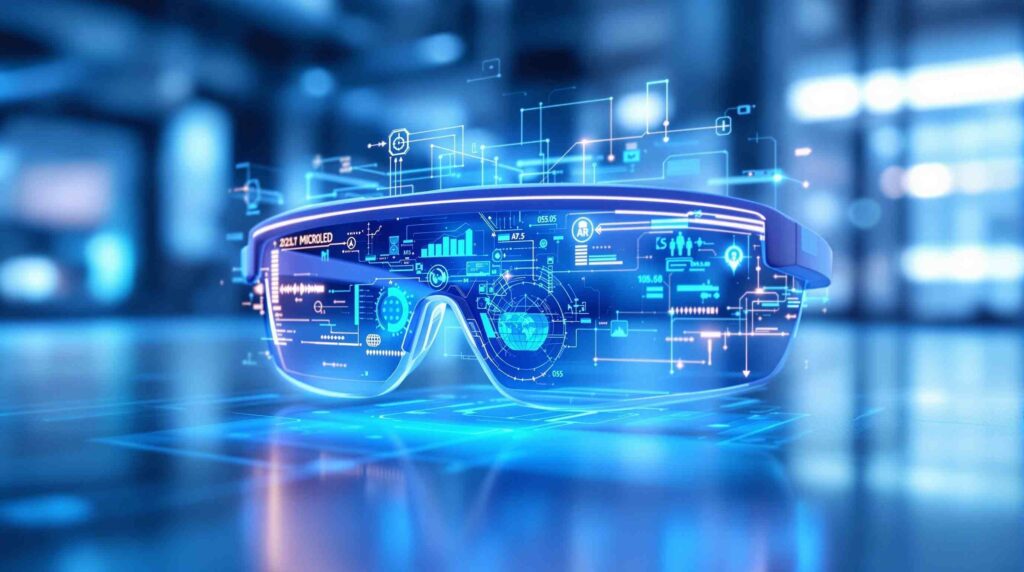
This isn’t hype. It’s infrastructure. Smart glasses are transitioning from “tech demos” to workflow infrastructure, with procurement teams across Europe and the Middle East now treating them as core operational tools governed by delivery metrics and compliance cycles.
Let’s explore the five technology trends defining who scales—and who stalls—in 2025-2026.
Trend 1: AI-First Architecture Becomes Standard
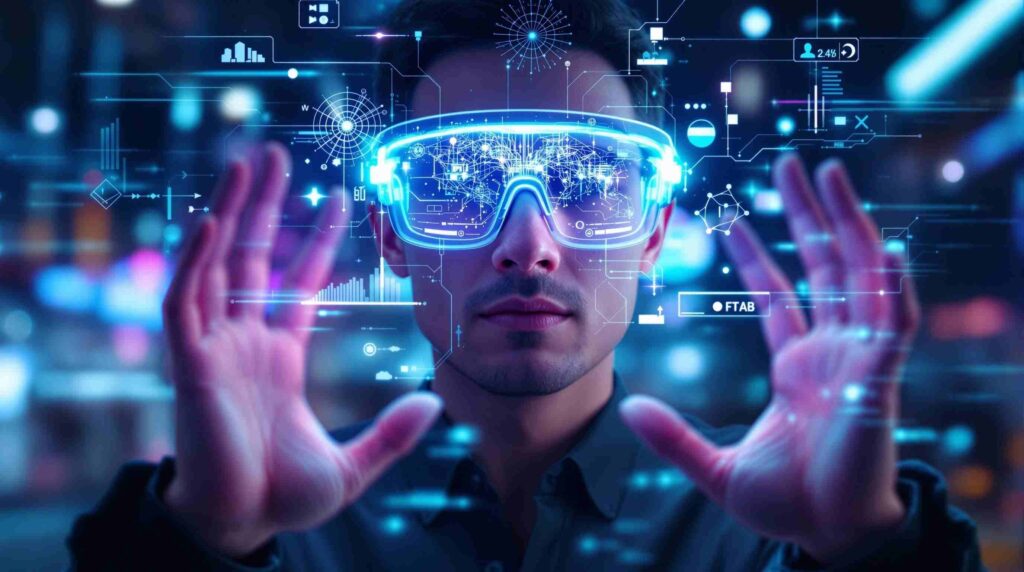
The biggest shift in smart glasses technology isn’t hardware—it’s the AI layer powering it. Modern smart glasses now integrate multimodal AI models capable of processing vision, audio, and contextual data simultaneously.
What This Looks Like in Practice:
- Meta Ray-Ban Smart Glasses: Live AI feature responds to visual and audio prompts in real-time. Ask “What kind of tree is that?” while looking at foliage, and Meta AI provides instant botanical identification.
- Google Android XR Glasses: Gemini AI agent offers unprompted contextual assistance—reminding you to buy groceries when passing a store or identifying coworkers in crowded events.
- Enterprise AI Overlays: Warehouse workers see object-recognition overlays for maintenance tasks, reducing error rates by 22% and task completion time by 31% (UAE/Spain logistics trial).
Neural Interface Integration
The frontier beyond voice and touch? Neural control systems. Meta’s upcoming Artemis AR glasses (2027 launch target) will feature a wristband that reads nerve signals from hand movements to control the interface—no physical buttons required.
Key Insight: By 2026, buyers will judge smart glasses not by sensor count, but by AI capability and firmware discipline. Every OEM is now evaluated on on-device translation engines, secure edge-cloud synchronization, and MES-integrated firmware traceability.
Trend 2: MicroLED + Waveguide Optics Mature
For years, bulky optics prevented AR glasses from looking like regular eyewear. That’s changing with MicroLED displays paired with waveguide technology—the combination enabling full-color AR overlays in frames thin enough to pass for Ray-Bans.
Technical Breakthrough Snapshot
| Component | 2023 Baseline | 2025 State-of-Art | Impact |
|---|---|---|---|
| MicroLED Engine Size | 1.2 cm³ | 0.4 cm³ (JBD/RayNeo) | 67% size reduction |
| Waveguide Efficiency | 8-12% light | 35%+ (Lumus) | 3-7x brighter |
| FOV (Field of View) | 23° diagonal | 45°+ (Meta Orion) | Doubled immersion |
RayNeo’s X3 Pro represents third-generation full-color waveguide AR glasses, partnering with JBD (Jade Bird Display) and Applied Materials to achieve 880 nits brightness (readable in direct sunlight), full RGB color depth, and prescription lens compatibility.
Vuzix and TCL CSOT are co-developing a total optical solution combining MicroLED engines with waveguides, targeting early 2026 release. Meta’s confirmed use of silicon carbide (SiC) optical waveguides signals industry-wide commitment to this architecture.
Consumer Impact: Expect 2026 AR glasses to look indistinguishable from designer frames while projecting 215-inch equivalent screens in your field of view.
Trend 3: Enterprise Adoption Drives Durability Standards
Since Q2 2025, over 70% of smart glasses RFQs (Request for Quotation) now demand:
- ✅ Dual Compliance: CE (Europe) + FCC (North America) certification
- ✅ UI Localization: Support for 5-8 languages minimum
- ✅ Rapid Deployment: Prototype-to-pilot delivery under 90 days
- ✅ Extreme Durability: 5,000+ hinge-fold cycles, 45°C thermal stability
This represents a fundamental market shift: Buyers no longer compare smart glasses to smartphones—they compare them to ruggedized industrial handhelds and inspection cameras.
Real-World Impact: Middle East distributors report 50% reduction in return rates after switching to models meeting these durability standards. A German system integrator shortened launch time by 26% by consolidating optics, battery, and housing sourcing under single OEM processes.
Trend 4: Ecosystem Interoperability Over Standalone Devices
Smart glasses are evolving from standalone devices to nodes in a connected wearable ecosystem. Enterprise users now expect seamless integration with:
- Smart Rings: Gesture control without raising hands
- Smart Watches: Biometric data (heart rate, GPS) fed into AR displays
- Translator Earbuds: Voice collaboration synchronized with visual overlays
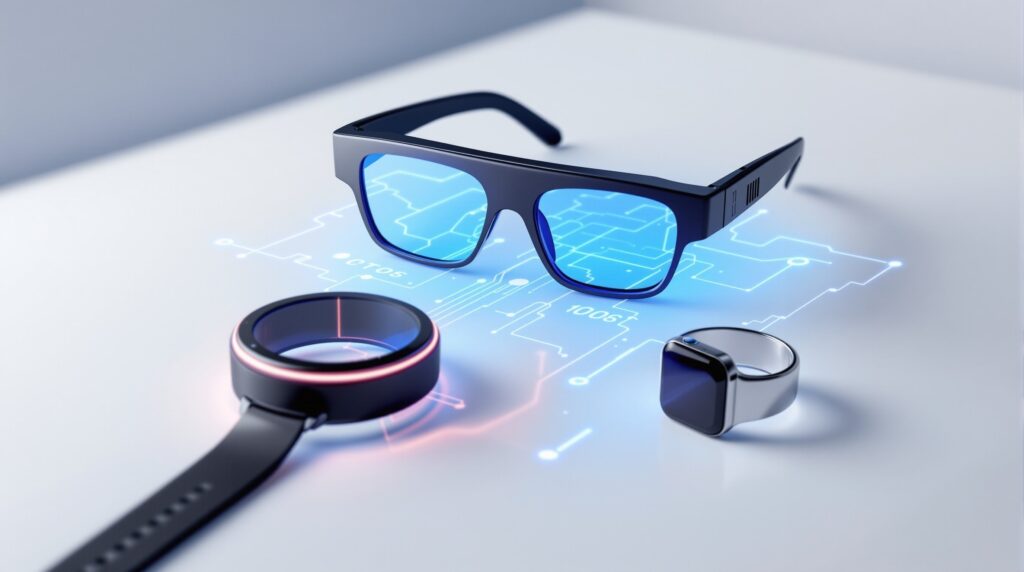
To deliver synchronized analytics, all devices must share firmware protocols, APIs, and compliance logic (CE + RoHS certification for entire ecosystem). Goodway Techs’ wearable ecosystem already synchronizes power management and firmware updates across rings, glasses, and watches—tested under European regulatory regimes.
Android XR’s Strategic Advantage: Google’s approach mirrors its smartphone strategy—building an OS that runs on glasses made by multiple manufacturers (Samsung, Sony, LG confirmed partners). This creates instant ecosystem scale, unlike Meta’s vertically integrated approach.
Trend 5: Privacy-First Design Becomes Non-Negotiable
The original Google Glass failed partly due to privacy concerns—people felt uncomfortable around wearers who could secretly record them. Ten years later, the industry has learned its lesson.
2025-2026 Privacy Standards:
- ✅ Visual Recording Indicators: LED lights activate during video capture
- ✅ On-Device AI Processing: Sensitive data analyzed locally, not cloud
- ✅ Granular Permission Controls: Explicit camera/microphone access per app
- ✅ Facial Recognition Bans: Major brands prohibit facial recognition in consumer models
- ✅ Data Minimization: Only collect data essential for function
The smart glasses industry is proactively establishing privacy standards to avoid regulatory backlash. Meta’s partnership with EssilorLuxottica includes privacy-by-design clauses, while Google’s Android XR includes built-in privacy dashboards showing real-time data access.
Regional Market Dynamics: EMEA vs. North America vs. APAC
The global smart glasses market isn’t uniform—regional priorities shape product development:
Europe & Middle East (EMEA)
Top Priority: CE documentation readiness
Challenge: Tight regulatory audits
Growth Driver: Industrial/logistics use cases
North America
Top Priority: AI feature depth
Challenge: Data-privacy compliance (state-level variations)
Growth Driver: Consumer AI assistant adoption
Asia-Pacific
Top Priority: Cost-to-performance ratio
Challenge: Fragmented vendor base
Growth Driver: Gaming and entertainment applications
Market Size Projections
- 2024: 3.3 million units shipped globally
- 2026: 13 million units (ABI Research forecast)
- 2030: 35 million units (47% CAGR from 2025-2030)
- Dollar Value: $1.30 billion (2024) → $3.01 billion (2032)
The Software Stack: Who’s Building the OS?
Smart glasses need operating systems, and three platforms are competing for dominance:
Meta Horizon OS
- Partners: Ray-Ban (EssilorLuxottica), Oakley
- Strength: Mature social integration, largest install base
- Weakness: Closed ecosystem (limited third-party hardware)
Android XR
- Partners: Samsung, Sony, LG (hardware); Qualcomm (chipsets)
- Strength: Open ecosystem, developer familiarity
- Weakness: Fragmentation risk (different OEM implementations)
Proprietary Systems
- Snap OS (Spectacles): Creator-focused tools
- Vuzix AugmentOS: Universal SDK for enterprise developers
- Brilliant Labs noa (OS): AI-first, runs Perplexity/ChatGPT
The Takeaway: Developers building for Android XR can reach multiple hardware brands simultaneously—a massive advantage over Meta’s walled garden. But Meta’s lead in consumer sales (1M+ units) means developers can’t afford to ignore Horizon OS.
Challenges Still Holding Back Mass Adoption
Despite rapid progress, smart glasses face persistent hurdles:
1. Battery Life Constraints
Current models max out at 6-12 hours active use—insufficient for all-day wear. Users expect eyewear to “just work” without daily charging rituals.
2. Social Acceptance (“Glasshole 2.0” Risk)
Even with LED recording indicators, many people feel uncomfortable around smart glasses wearers. Bars, gyms, and schools are preemptively banning them.
3. Prescription Lens Complexity
Integrating AR displays into prescription lenses remains expensive and complex. Most users wear contact lenses with non-prescription smart glasses.
4. Developer Ecosystem Gaps
Compared to smartphone app stores (millions of apps), smart glasses platforms have dozens to hundreds of apps. Chicken-and-egg problem: Developers won’t build without users, users won’t buy without apps.
Expert Predictions: What Industry Leaders Are Saying
Mark Zuckerberg (Meta CEO): “2025 will be a defining year for understanding whether AI glasses explode in popularity or represent a longer grind. But I’m confident Meta’s glasses are the perfect form factor for AI.”
Sergey Brin (Google Co-Founder): “Smart glasses are the killer app for AI. This isn’t just augmenting your world, it’s augmenting your brain.”
Louis Rosenberg (AR Pioneer, Stanford): “Having worked on mixed reality for over 30 years, it’s the first time I can see an application that will really drive mass adoption.”
Frequently Asked Questions
What are the biggest smart glasses technology trends in 2025?
The five dominant trends are: (1) AI-first architecture with multimodal models, (2) MicroLED + waveguide optics enabling slim AR glasses, (3) Enterprise adoption driving durability standards, (4) Ecosystem interoperability connecting wearable devices, and (5) Privacy-first design addressing social acceptance concerns.
When will smart glasses have displays?
Several models already feature displays in 2025: Snap Spectacles (5th gen), Vuzix Z100, RayNeo X3 Pro, and Rokid Max 2. Meta’s third-generation Ray-Ban glasses with displays launch mid-2025, while Google’s Android XR glasses debut late 2025. Expect displays to become standard across premium models ($400+) by 2026.
Are smart glasses safe for daily use?
Yes, when meeting 2025 safety standards: LED recording indicators (visual privacy), on-device AI processing (data security), eye-safe display brightness (<0.5mW laser power), and thermal management systems (preventing overheating). Regulatory certifications (CE, FCC, RoHS) verify compliance with health/safety requirements.
What’s the difference between AI glasses and AR glasses?
AI glasses (e.g., Meta Ray-Ban) focus on voice/camera AI without displays—they’re smart sunglasses with conversational AI assistants. AR glasses (e.g., Meta Orion, Google Android XR) add heads-up displays projecting digital information over real-world views. Many 2025-2026 models blur this distinction by combining AI assistants with lightweight AR displays.
How long do smart glasses batteries last?
Current models range from 4-12 hours active use: Meta Ray-Ban (4 hours streaming, 36 hours standby), Snap Spectacles (45 minutes AR, 5 days standby), Vuzix Blade (6 hours mixed use), and enterprise models like RealWear Navigator (8-12 hours industrial deployment). By 2026, expect 8-hour minimums becoming standard.
Can you get prescription smart glasses?
Limited options currently exist: Some brands offer prescription lens inserts (add bulk), while Vuzix and Lumus demonstrated direct waveguide casting into prescription lenses (expensive, limited optical power range). Most users wear contact lenses with non-prescription smart glasses. Expect more native prescription integration by late 2026.
The Bottom Line: Are We Finally Ready?
After a decade of false starts, smart glasses technology has reached critical maturity across five dimensions:
- ✅ Hardware: MicroLED + waveguide optics enable stylish, lightweight AR
- ✅ Software: Multimodal AI transforms glasses from novelties into contextual assistants
- ✅ Manufacturing: OEM supply chains deliver <90-day prototype-to-pilot cycles
- ✅ Compliance: Dual CE/FCC certification and industrial durability standards met
- ✅ Ecosystem: Interoperability with smart rings, watches, and earbuds
The remaining barrier: Social acceptance. Technology is ready. Society needs another 12-24 months to normalize face-worn cameras.
For end users: If you need hands-free AI assistance today, BKWAT delivers proven value at $99. If you want AR displays, wait for Android XR glasses (late 2025) or Meta’s third-gen Ray-Bans (mid-2025). If you need prescription lenses, wait until 2026-2027 for better integration options.
The smart glasses revolution is no longer coming—it’s here. The question isn’t whether these devices will succeed, but which platforms, brands, and ecosystems will dominate the next decade of human-computer interaction.
For deeper dives into specific technologies, explore our related guides: How Smart Glasses Work and Smart Glasses Technology Explained.
🚀 Need Professional Smart Glasses Android Integration?
Contact us for OEM/ODM smart glasses android services. Our team specializes in Android compatibility solutions, custom firmware development, and seamless mobile integration for smart eyewear manufacturers.